

The Tesseract: Core Architecture and Cubes
Lesson Details
This foundational lesson introduces the tesseract as a four-dimensional hypercube model for understanding how knowledge and perspective operate in multi-dimensional reality. Students will learn the theoretical framework of the eight cubes of epistemic access and why geometric frameworks matter for consciousness studies.

🎙️ Related Podclass
Lesson Content
The Tesseract as Cognitive Prosthetic
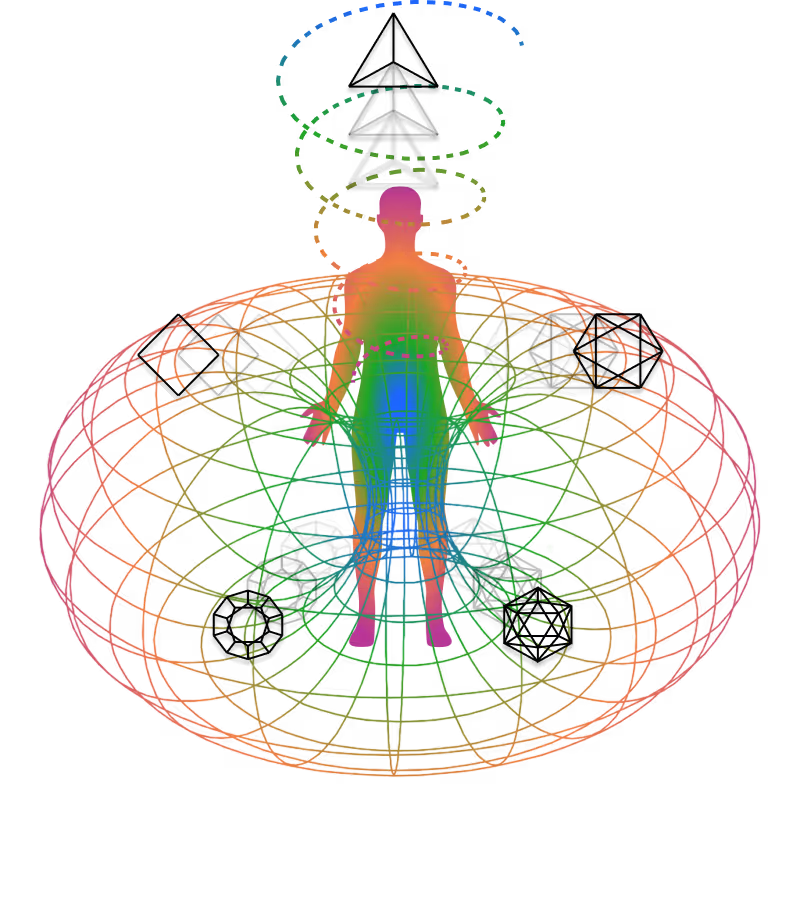
The tesseract—a four-dimensional hypercube—serves as the central geometric architecture of the SolarPunk Mandala's epistemological framework. Unlike literal claims about physical reality, the tesseract functions as a cognitive prosthetic—a tool for mapping how a unified field of consciousness (Mind at Large) appears as a multi-perspectival reality through eight distinct cubes of epistemic access.
This geometric structure provides what materialist frameworks lack: a coherent map of how different ways of knowing relate to each other without reducing them to a single perspective. In materialism, only third-person objective knowledge is considered valid, while first-person subjective experience is often dismissed as illusory. The tesseract framework honors multiple epistemic modes as equally valid expressions of consciousness experiencing itself.
From Three Dimensions to Four Dimensions
Three-dimensional geometry (length, width, height) maps the physical world we perceive, but it cannot adequately represent the multi-dimensional nature of consciousness and knowing. The tesseract adds a fourth dimension—not time in the conventional sense, but dimensionality itself—the capacity for consciousness to experience itself from multiple perspectives simultaneously.
This fourth dimension is crucial for understanding how knowledge works in complex systems. In three dimensions, we see only surfaces and boundaries; in four dimensions, we perceive relationships, connections, and the underlying patterns that give rise to apparent separateness. The tesseract doesn't just show what we know—it reveals how knowing itself operates across multiple dimensions of reality.
The Eight Cubes of Epistemic Access
The tesseract's eight cubes represent distinct modes of knowing and being that emerge from the Embodied Foundations Core. These cubes are not merely theoretical constructs but practical navigational tools for understanding how we experience reality from different perspectives.
Four of these cubes are "unfolded"—inhabitable perspectives we can occupy and identify with:
- UR (Upper Right): 3rd-person exterior, individual—biological, physical, and spatial dynamics
- UL (Upper Left): 1st-person interior—subjective experience, meaning, and inner life
- LL (Lower Left): 2nd-person interior—shared meaning, culture, and dialogue
- LR (Lower Right): 3rd-person exterior, collective—institutions, systems, and collective patterns
Four cubes are "folded"—boundary dimensions where transformation occurs:
- Cube 5: The Dissociation Boundary—where Mind at Large partitions into individual alters
- Cube 6: The Intersubjective Gateway—where "mine" becomes "ours"
- Cube 7: The Systemic Emergence Plane—where collective patterns emerge from individual actions
- Cube 8: The Meta-Perspective—non-perspectival center equidistant from all quadrants
This eight-cube structure honors the complexity of human knowing while providing a coherent map for navigating it. Unlike reductionist frameworks that collapse all knowledge into a single dimension (usually the UR objective exterior), the tesseract acknowledges that full understanding requires integration across multiple epistemic modes.
The Central Null Point: Embodied Foundations Core
The Embodied Foundations Core (Ø) is not merely another cube but the geometric and functional center of the entire tesseract structure. This null point represents the dissociative boundary of Mind at Large experiencing itself—a position that enables all other perspectives while remaining itself perspective-less. The four embodied foundations (Nourishment, Cleansing, Restoration, Movement) are not separate dimensions but the essential ground from which all eight cubes emerge.
This central positioning transforms how we understand the relationship between abstract consciousness and concrete reality. Unlike traditional frameworks that place the spiritual or mental realms at the center with physical reality as peripheral, the Mandala inverts this hierarchy. The embodied foundations are positioned as the gateway through which Mind at Large becomes accessible to its dissociated expressions. This architectural choice prevents the spiritual bypassing that plagues many consciousness frameworks by ensuring that all higher-dimensional work remains grounded in physical reality.
🤌 Key Terms
Tesseract - A four-dimensional hypercube used as a cognitive prosthetic to map the eight cubes of epistemic access through which reality appears as multi-perspectival.
Cognitive Prosthetic - A conceptual or geometric tool that extends human cognition beyond its natural limitations, enabling navigation of complex systems and perspectives.
Unfolded Cubes - The four inhabitable perspectives (UR, UL, LL, LR) representing different modes of knowing and being in the world.
Folded Cubes - The four boundary dimensions (5-8) where transformation occurs—these are not merely perspectives but interfaces where consciousness heals its own dissociations.
Embodied Foundations Core (Ø) - The geometric and functional center of the Mandala, representing the dissociation boundary where Mind at Large partitions into individual alters.
🤌 Reflection Questions
Reflect on key questions from this lesson in our Exploration Journal.

Dimensional Awareness - Reflect on a recent experience where you felt limited by a single perspective (e.g., only seeing the objective facts of a situation without considering emotional or cultural dimensions). How might the tesseract model help you access additional cubes of knowing in similar situations?
Cognitive Mapping - Draw a simple diagram representing the eight cubes of the tesseract as you understand them. Where do you feel most comfortable dwelling in this map? Where do you feel most alien?
Null Point Reflection - How does the concept of the "null point" at the center of the tesseract challenge your understanding of perspective and knowing? What might it mean to occupy a position that enables all perspectives while remaining perspective-less?
Lesson Materials


