

Integrating Multiple Ways of Knowing
Lesson Details
This culminating lesson explores how the Tesseract framework integrates diverse epistemic modes—from scientific rationality to embodied wisdom, from ancestral memory to technological intelligence—into a coherent system for navigating complexity. Students will understand how to move fluidly between different ways of knowing while maintaining ontological clarity about consciousness as primary.

🎙️ Related Podclass
Lesson Content
The Integration Imperative
Modern education typically fragments knowledge into isolated disciplines, each with its own methods and assumptions about what counts as valid knowing. The Tesseract framework addresses this fragmentation by providing geometric architecture for integration—not by reducing all knowledge to a single dimension, but by honoring each epistemic mode while showing how they interconnect within Mind at Large's unified field.
This integration isn't merely theoretical but responds to urgent practical needs. Climate change, social inequality, and meaning collapse cannot be addressed through single-discipline approaches. The Tesseract provides what the framework calls "dimensional intelligence"—the capacity to recognize which epistemic modes are most appropriate for different contexts while maintaining awareness of their interconnections.
The framework recognizes that integration without integrity creates chaos, while integrity without integration creates fundamentalism. True integration maintains the unique contributions of each way of knowing while revealing their underlying unity. This requires what the framework terms "methodological openness with ontological clarity"—holding consciousness as primary while remaining open to multiple approaches that may operate with different metaphysical assumptions.
Beyond the Science-Spirituality Divide
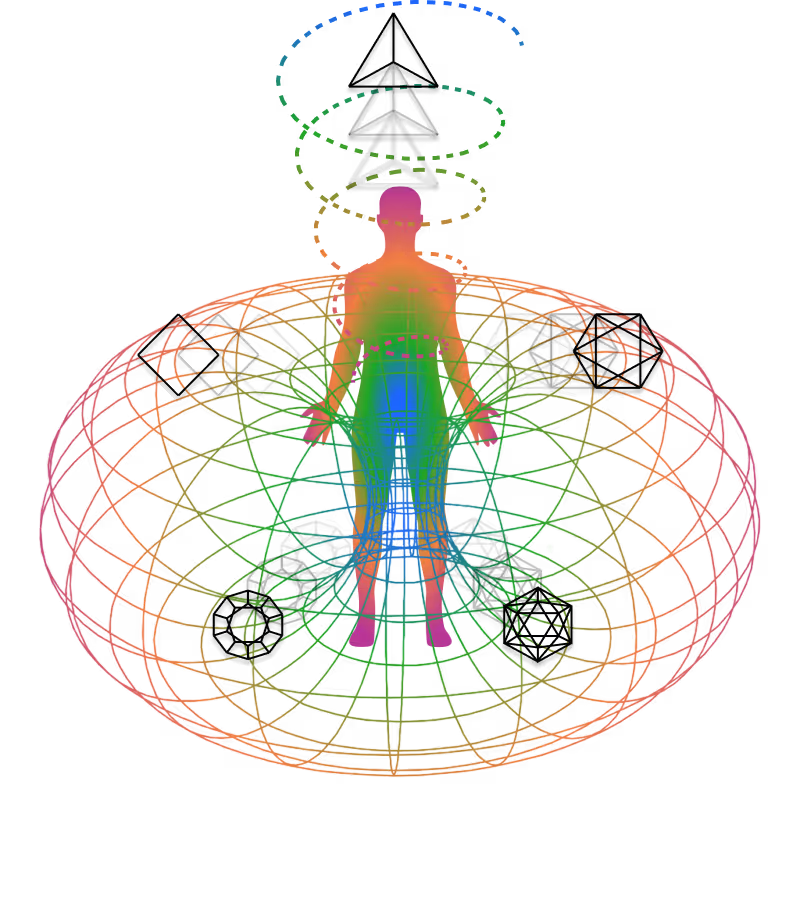
The Tesseract framework resolves the false dichotomy between scientific and spiritual ways of knowing by positioning both as valid expressions of Mind at Large experiencing itself through different boundaries. Scientific knowing (UR cube) provides precise measurement and prediction; spiritual knowing (UL cube) offers meaning and connection; cultural knowing (LL cube) creates shared understanding; systemic knowing (LR cube) reveals patterns across scales.
Rather than forcing these modes to compete, the Tesseract creates what the framework calls "convergence without compromise." A community addressing food insecurity might include members who see consciousness as primary and members who see it as emergent, but all can agree that collective gardening practices that honor soil intelligence create more resilient food systems. The geometric architecture provides a container for this convergence by mapping how different perspectives relate without reducing them to a single viewpoint.
This approach transforms epistemic conflicts from battles to be won into creative tensions to be held. When neuroscientists and meditators study consciousness together, they don't need to agree on whether consciousness produces the brain or the brain produces consciousness—they can collaborate on which practices create measurable changes in attention, emotional regulation, and social connection. The geometric map provides a neutral ground where different ways of knowing can inform each other without losing their essential character.
The Four Epistemic Gates
The framework identifies four essential gates that must open for true integration to occur. These gates correspond to the four ethical axes but function as epistemic filters that determine which ways of knowing can flow into the integrated system:
The Rational Gate requires honoring empirical evidence and logical coherence while recognizing their limitations. Science excels at describing how systems work but often struggles with why they matter. The Tesseract honors scientific method while expanding its boundaries to include first-person experience as valid data. This gate opens when communities develop practices that honor both objective measurement and subjective meaning.
The Embodied Gate demands that abstract knowledge be grounded in physical reality through the four foundations. Theoretical understanding of climate change becomes meaningful only when connected to embodied experience of seasonal shifts, food system changes, and community impacts. This gate prevents spiritual bypassing and philosophical-materialist slippage by requiring that all knowing be tested against embodied reality.
The Cultural Gate acknowledges that all knowing is culturally situated. Western science, Indigenous wisdom, and contemplative traditions each offer unique epistemic tools that become more powerful when integrated rather than forced into hierarchy. The Tesseract honors cultural context while identifying universal patterns that transcend specific traditions. This gate opens when communities honor diverse cultural ways of knowing without requiring assimilation.
The Temporal Gate requires holding past wisdom, present experience, and future vision simultaneously. This gate heals the dissociation between historical memory and future possibility, recognizing that true innovation builds on ancestral knowledge while creating new patterns for future generations. The gate opens when communities can draw on historical patterns without being bound by them, and envision future possibilities without losing connection to their roots.
When all four gates are open, communities develop what the framework calls "epistemic agility"—the capacity to move fluidly between different ways of knowing while maintaining coherence. This isn't relativism (all ways of knowing are equal) but contextual wisdom (different ways of knowing serve different purposes with a unified field).
Boundary Permeability as Integration Technology
The Tesseract's most powerful integration tool is boundary permeability—the design principle that healthy boundaries allow circulation while maintaining integrity. In the context of epistemology, this means creating interfaces between different ways of knowing that allow cross-pollination without losing essential characteristics.
The Hexagonal Connection Map operationalizes this principle by making visible the interfaces between different epistemic domains. When a community maps their knowledge systems hexagonally, they can see not just where different ways of knowing exist in isolation, but where transformative connections can occur. A high-scoring SCIENCE-INDIGENOUS interface might allow ecological monitoring data to inform traditional land stewardship practices, while a high-scoring ART-SCIENCE interface might enable data visualization to communicate climate patterns through aesthetic experience.
This boundary permeability prevents both epistemic siloing (where disciplines become isolated fortresses) and epistemic imperialism (where one way of knowing dominates all others). Instead, it creates what the framework calls "epistemic symbiosis"—where different ways of knowing mutually enhance each other while maintaining their unique contributions.
The framework provides specific practices for designing permeable epistemic boundaries:
Translation Practices create bridges between different knowledge systems. These include bilingual facilitators fluent in multiple epistemic languages, visual mapping tools that make abstract concepts tangible, and metaphor development that helps translate between domains. For example, a community might use water flow metaphors to help engineers understand Indigenous water rights concepts.
Ritual Integration Practices create shared experiences that bypass intellectual barriers. These include seasonal ceremonies that honor multiple traditions, collaborative art projects that make invisible patterns visible, and shared meals that build relationship before debate. These practices create what the framework calls "embodied convergence"—where different ways of knowing meet in the body before the mind.
Feedback Loop Design creates systems that allow different ways of knowing to inform and correct each other. These include participatory evaluation processes that honor both quantitative and qualitative measures, multi-perspective decision-making that requires input from different epistemic domains, and reflection practices that help communities learn from their integration experiments.
Multiple Intelligences Integration Protocol
The framework offers a specific protocol for integrating multiple intelligences within the Tesseract architecture. This protocol moves beyond simply adding intelligences as separate components to weaving them into the geometric structure:
Step 1: Intelligence Mapping to specific cubes and axes. Each intelligence has primary and secondary alignments:
- Embodied Intelligence maps primarily to UR + Cube 5
- Ancestral Intelligence maps primarily to LL + Cube 8
- Aesthetic Intelligence maps primarily to UL + Cube 6
- Disability Intelligence maps primarily to UR + Cube 5 but with unique cross-cube connections
Step 2: Dialectical Phase Alignment recognizes that different intelligences become primary at different transformation phases:
- 0D-1D phases prioritize Embodied and Material Intelligence for survival and stability
- 1D-2D phases prioritize Collective Sensemaking and Boundary Intelligence for connection
- 2D-3D phases prioritize Ancestral and Aesthetic Intelligence for deeper meaning
- 3D-4D phases integrate all intelligences in participatory consciousness
Step 3: Rhizomatic Cross-Walk Enhancement strengthens specific Ekistics-Circles interfaces through intelligence activation:
- NATURE-ECOLOGY interface strengthens through Ecological and Ancestral Intelligence
- MAN-SPIRITUALITY interface strengthens through Embodied and Childhood Intelligence
- SOCIETY-POLITICS interface strengthens through Collective Sensemaking and Disability Intelligence
Step 4: MAL Reflection Requirement ensures every intelligence practice includes the question: "How does this help us remember our belonging to Mind at Large?" This maintains ontological clarity while allowing methodological diversity.
From Integration to Co-Creation
When integration reaches its highest expression, it becomes what the framework calls "participatory co-creation"—where diverse ways of knowing don't just coexist but actively generate new possibilities through their interaction. This is the difference between a multicultural potluck (diverse dishes served side by side) and fusion cuisine (new dishes created through intentional blending).
In community contexts, participatory co-creation might look like:
- Food sovereignty initiatives where scientific soil analysis, Indigenous land stewardship practices, and economic justice frameworks combine to create regenerative food systems that neither science nor tradition alone could design
- Climate adaptation planning where predictive climate models, traditional ecological knowledge, and participatory design methods create resilient communities that honor both data and wisdom
- Conflict transformation where trauma-informed therapy, restorative justice practices, and spiritual wisdom traditions heal community divisions through approaches that address body, mind, and spirit simultaneously
This co-creation isn't random mixing but intentional weaving guided by the Tesseract's geometric principles. Each way of knowing maintains its integrity while contributing to something greater than the sum of its parts—what the framework calls "emergent wisdom" that could not arise from any single epistemic mode alone.
The framework recognizes that participatory co-creation requires both structure and freedom. The geometric architecture provides the structure that prevents chaos, while the boundary permeability principles provide the freedom that prevents rigidity. This balance creates what the framework terms "structured emergence"—where new possibilities can arise within a coherent framework.
🤌 Key Terms
Epistemic Integration - The process of weaving different ways of knowing into a coherent system that honors their unique contributions while revealing their interconnections. This differs from epistemic reduction (collapsing all knowledge into one mode) and epistemic fragmentation (keeping knowledge modes isolated).
Convergence Without Compromise - The principle that different perspectives can converge on practical actions while maintaining their distinct metaphysical assumptions. This creates bridges between seemingly incompatible worldviews without requiring anyone to abandon their core beliefs.
Epistemic Agility - The capacity to move fluidly between different ways of knowing while maintaining coherence. This skill allows practitioners to select appropriate epistemic tools for different contexts while understanding how these tools interconnect.
Participatory Co-Creation - The highest expression of epistemic integration, where diverse ways of knowing actively generate new possibilities through their interaction. This creates emergent wisdom that could not arise from any single epistemic mode alone.
Methodological Openness with Ontological Clarity - The principle of maintaining consciousness as primary while remaining open to multiple methods and research approaches. This bridges secular and sacred domains without compromising foundational principles.
🤌 Reflection Questions
Reflect on key questions from this lesson in our Exploration Journal.

Integration Assessment - Which of the four epistemic gates (Rational, Embodied, Cultural, Temporal) feels most open in your life? Which feels most closed? How does this pattern affect your capacity to integrate different ways of knowing?
Boundary Permeability Practice - Identify one boundary between different ways of knowing in your life that feels too rigid. What small practice might help make this boundary more permeable while maintaining necessary integrity? For example, if you keep scientific and spiritual knowing separate, what practice might help them inform each other?
Co-Creation Vision - Imagine a project or initiative that would benefit from participatory co-creation between different epistemic modes. What would this look like in your community? What barriers would need to be addressed to make this possible?
Methodological Bridge-Building - How might you use the principle of "methodological openness with ontological clarity" to create dialogue between people with seemingly incompatible worldviews? What shared ground exists that could serve as a starting point?
Emergent Wisdom Reflection - Recall a time when combining different ways of knowing in your life created insight that wouldn't have emerged from any single approach. What conditions made this possible? How might you intentionally create similar conditions in the future?
Lesson Materials


