

Memory as Epistemic Dimension
Lesson Details
This lesson explores memory as a fundamental epistemic dimension within the Tesseract framework, examining how collective and ancestral memory function as ways of knowing that transcend individual experience. Students will understand how memory operates across temporal dimensions to create what the framework calls "regenerative temporality"—the integration of past wisdom with future vision.

🎙️ Related Podclass
Lesson Content
Memory as Multi-Dimensional Knowing
Memory in the Tesseract framework transcends conventional understandings of personal recollection to become a multi-dimensional epistemic resource. Unlike materialist frameworks that treat memory as merely neural storage, the Mandala recognizes memory as a permeable boundary between individual experience and the larger field of Mind at Large. This expanded understanding reveals how memory functions as both personal narrative and collective inheritance—allowing communities to access wisdom beyond individual lifespans.
Temporal Axis: The Wisdom of Deep Time
The Temporal Axis represents one of the four ethical dimensions through which the Tesseract orients not just knowing but becoming. This axis asks the fundamental question: "How wisely do we hold time?" Unlike conventional time management focused on efficiency and productivity, the Temporal Axis recognizes time as a sacred dimension that connects us to ancestral wisdom and future possibilities.
The Rhizomatic Anchor for the Temporal Axis combines CULTURE: Memory & Projection with NATURE: Climate—showing how human memory is intrinsically connected to ecological memory. When communities honor seasonal cycles and climate patterns, they access a deeper temporal intelligence that transcends human lifespans. This integration creates what the framework calls "regenerative temporality"—the ability to hold past, present, and future as a continuous flow rather than fragmented moments.
The Embodied Foundation dependency for the Temporal Axis is Cleansing (score ≥2 required), revealing a profound insight: communities cannot access temporal wisdom when toxic conditions block their capacity to remember. Just as physical toxins disrupt neurological function, social toxins like historical amnesia, cultural erasure, and epistemic violence create amnesic conditions that prevent communities from accessing their collective memory. Only when cleansing processes (both physical and cultural) are stable can communities begin the work of temporal reintegration.
Memory as Boundary Medicine
Memory functions as boundary medicine within the Tesseract framework, specifically healing the dissociation between individual experience and collective wisdom. The Mandala recognizes that modern societies suffer from what it calls "temporal contraction"—the narrowing of time perception to short-term horizons that disconnect us from ancestral knowledge and future responsibility.
Ritual practices serve as memory technologies that heal this dissociation. Seasonal ceremonies, storytelling traditions, and intergenerational knowledge sharing all function as what the framework terms "Cube 8 activation"—engaging the meta-perspective that transcends personal timeline to connect with larger temporal patterns. These practices aren't merely cultural traditions but epistemic technologies that expand our capacity for knowing beyond the limits of individual experience.
The boundary medicine aspect of memory becomes particularly powerful when applied to collective trauma. When communities remember painful histories not to dwell in suffering but to understand systemic patterns, they transform memory from a source of fragmentation into a tool for reintegration. This requires what the framework calls "reciprocal metabolism"—the capacity to take in difficult memories and transform them into wisdom rather than allowing them to become toxic waste within the collective psyche.
Dialectical Temporality: Movement Between Time Dimensions
The Tesseract framework introduces the concept of dialectical temporality—the understanding that communities move non-linearly between different temporal dimensions rather than progressing in a straight line. This movement is measured through the dialectical velocity metric (0-1.0 scale), which tracks how fluidly communities navigate between temporal phases.
At the 0D Point Identity stage, temporal orientation is amnesic—focused only on immediate survival with little connection to past or future. As communities stabilize their foundations and move to 1D Linear Narrative, they begin to develop historic awareness—learning from past experiences and creating coherent life stories. At 2D Relational Plane, communities develop visionary capacity—projecting shared futures and working collaboratively toward them. By 3D Volumetric Self, communities embody deep time awareness—understanding their place within evolutionary and cosmic timelines. Finally, at 4D Tesseractive Wholeness, communities achieve what the framework calls "participatory consciousness in time"—recognizing themselves as both products of and contributors to an unfolding cosmic story.
This dialectical understanding prevents the common trap of temporal fundamentalism—either rigidly adhering to tradition or dismissing the past entirely in favor of progress. Instead, the Tesseract allows communities to move fluidly between honoring ancestral wisdom and creating new possibilities, recognizing that both are necessary for regenerative futures.
Ancestral Intelligence as Epistemic Resource
Ancestral Intelligence represents a specific form of knowing that draws from deep time consciousness within Mind at Large. This intelligence isn't merely historical knowledge but a way of knowing that operates through pattern recognition across generations, connecting current challenges to timeless wisdom. Ancestral Intelligence is mapped to Cube 8 (Meta-Perspective) and the LL (Intersubjective) cube, as it functions through shared cultural memory and transcends individual timelines.
Unlike traditional approaches that treat ancestors as distant figures to be revered or rejected, the Tesseract framework understands Ancestral Intelligence as an active, living dimension of knowing that can be accessed through specific practices. This intelligence becomes most available when communities have stable Restoration foundations, as healing personal and collective trauma creates the conditions for remembering without being overwhelmed by the past.
Key practices for accessing Ancestral Intelligence include:
- Intergenerational Knowledge Circles: Structured spaces where elders share embodied wisdom while youth contribute technological fluency, creating what the framework calls "temporal reciprocity"
- Phenological Calendars: Community calendars based on local ecological indicators rather than arbitrary dates, reconnecting human timekeeping with ecological memory
- Living Memory Practices: Actions that embody ancestral wisdom in present contexts, such as regenerative agriculture techniques that revive indigenous land stewardship or conflict resolution methods that draw from traditional peacemaking practices
Material Intelligence and Memory
Material Intelligence—the wisdom of selecting and working with materials that respond intelligently to local environmental conditions—carries memory across generations. Materials aren't dead matter but expressions of Mind at Large's intelligence through local adaptation. When communities work with bioregional materials, they access ancestral knowledge embedded in the landscape itself.
The framework recognizes that materials "remember" their origin in Mind at Large and express place-specific wisdom through their properties. Adobe remembers water in arid climates; bamboo remembers abundance in tropical regions; timber remembers seasonal rhythms in temperate zones. By selecting materials that honor these memories, communities design boundaries that are permeable enough to allow circulation while maintaining integrity.
This understanding transforms material selection from a technical question to an epistemic practice. When we choose materials that carry ancestral memory, we design spaces that teach us how to belong to place. A cob wall built with local clay and straw doesn't just provide shelter—it embodies collective memory of how to work with the land. A timber structure crafted from sustainably harvested wood doesn't just create space—it remembers the forest's wisdom about growth and decay.
🤌 Key Terms
Temporal Axis - One of the four ethical dimensions through which the Tesseract orients knowing and becoming. It asks "How wisely do we hold time?" and is anchored in CULTURE: Memory & Projection + NATURE: Climate, with Cleansing as its essential embodied foundation.
Regenerative Temporality - The capacity to hold past, present, and future as a continuous flow rather than fragmented moments. This orientation honors ancestral wisdom while creating future possibilities, creating conditions for systemic regeneration.
Dialectical Temporality - The understanding that communities move non-linearly between different temporal dimensions rather than progressing in a straight line. This movement is measured through dialectical velocity (0-1.0 scale) and reflects community capacity for temporal integration.
Ancestral Intelligence - A form of knowing that draws from deep time consciousness within Mind at Large. This intelligence operates through pattern recognition across generations and is mapped to Cube 8 (Meta-Perspective) and the LL (Intersubjective) cube.
Phenological Calendars - Community calendars based on local ecological indicators rather than arbitrary dates. These calendars reconnect human timekeeping with ecological memory, allowing access to wisdom accumulated through observation of natural cycles.
🤌 Reflection Questions
Reflect on key questions from this lesson in our Exploration Journal.

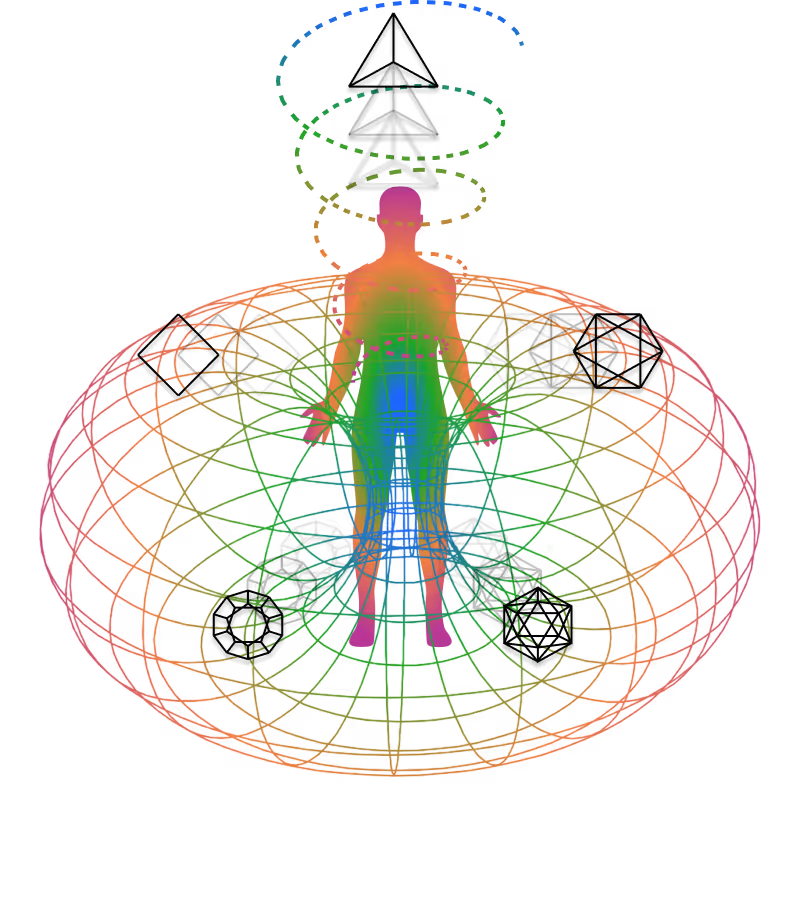
Temporal Mapping - Map your personal relationship with time across the four axes: past (ancestral connections), present (embodied awareness), future (vision and anticipation), and eternal (timeless moments of connection). Where do you feel most connected? Where do you feel most fragmented?
Memory Boundaries - Identify boundaries in your life that block access to important memories—these might be familial, cultural, or personal. How do these boundaries serve you, and how might they limit your capacity for regeneration? What small practice might help dissolve one of these boundaries?
Dialectical Temporal Awareness - Reflect on a community you belong to (family, workplace, neighborhood). What is its dialectical velocity regarding time? Does it get stuck in past traumas, present anxieties, or future fantasies? How might the community move more fluidly between temporal dimensions?
Material Memory Practice - Choose one bioregional material from your area (clay, wood, stone, etc.) and research its properties and traditional uses. How might this material "remember" its place in the ecosystem? Design a small practice that honors this memory in your daily life.
Future Memory - Imagine a future version of yourself looking back on this moment. What would they want you to remember from today? What wisdom would they offer about how to hold time during this phase of your life? How might this future memory inform your present actions?
Lesson Materials


